
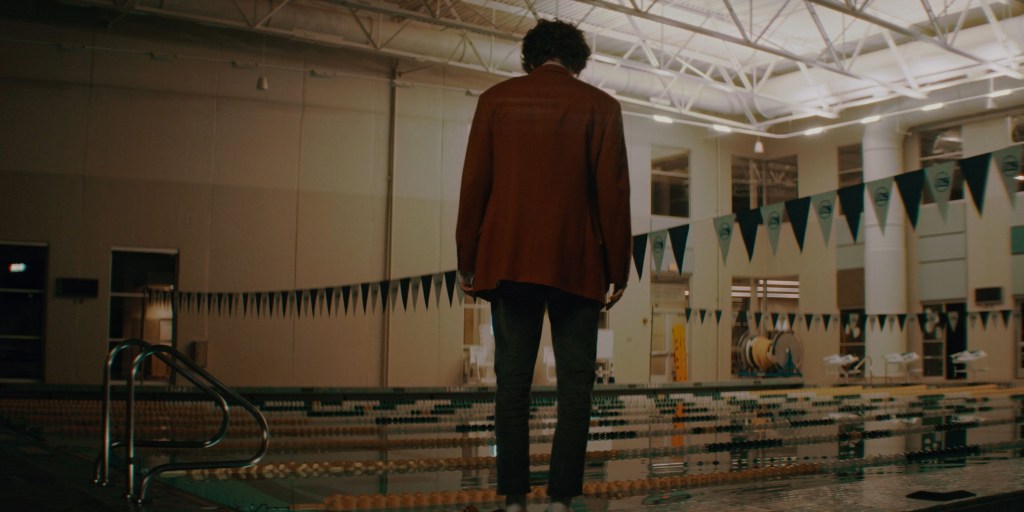
I feel fine. follows Ozzy Taylor, a charismatic high school teen who discovers he can’t control his intrusive thoughts of suicide.
Below is the transcript of my interview with Austin and Hailey Spicer, the writers and directors. Their film had its world premiere with two sold out showings at the 19th Sunscreen Film Festival hosted at the AMC Sundial in St. Petersburg, Florida.
The opening questions are from audience members in the Q&A after the second premiere showing. This interview assumes you have seen the film and contains major spoilers.
Audience Question: What inspired you to write this film?
Austin: The inspiration was everything Hailey and I experienced in our childhood or high school experiences. Them playing Apple baseball, that’s what I used to do with my friends instead of going to prom. The teacher, Mr. Wayman, is based off of my teacher. He was here last night, so it was really nice. Everything that you saw is something that either happened to me or Hayley, or it was one of our friends or family.
Hailey: We really wanted to make a love letter to friends that we’ve lost in our life.
Audience Question: What time frame was it set in? I was thinking 1970s, but then there’s Lady Gaga [audience laughter]
Austin: We really wanted to keep it timeless. We didn’t want to have anything that made it one specific time period.
Hailey: Just kind of like the friends hanging out, playing around. They didn’t have any phones. It’s kind of like how our high school experience was. We didn’t have social media yet. We just lived our life and had fun. That’s exactly what, when we casted with Elijah and Blake, we were like, they’re living in a different generation. They’re having fun and not being on their phones.
Kyle [TWR]: For some context, I watched the trailer, and I thought that this was a very forward Christian film. I want to tell you some of the reasons why and see if any of them touch on anything that’s accurate about the film.
One is when Ozzy jumps into the pool to attempt to drown himself, there are two crosses, one on each side of him in the pool.
Hailey: Crazy you noticed that. That’s wild.
Kyle [TWR]: Was that intentional, or is that sort of incidental to the fact of the pool? Did you wonder if people would read into that?
Austin: It was incidental, but at the time of filming I was literally in the water with goggles.
Hailey: Austin had a GoPro, he had swim trunks on.
Austin: But I was trying to find framing, and I’m like oh this is really cool looking.
And it’s not a religious thing at all, but I think what’s cool about that being like the cross, or X if you want to call it, is Scorsese does that a lot intentionally to let you know death is coming. So, it’s kind of interesting that those X’s were framed like that in the pool. It’s just something we found.
Hailey: If you look at some Scorsese films, there’s like… Yeah right before someone dies, he has like an X in tape or an X in something.
Kyle [TWR]: I didn’t know that about Scorsese, that’s interesting. Okay. Another reason: Kevin Sorbo and Dean Cain are known Christian film actors. They both have minor roles in it, but their presence also does… How did they become involved in the film?
Austin: We did a lot of low budget indie films, and a lot of them were faith-based films. And obviously they’re in the faith-based world. We’ve worked with them a lot. Really like their professionalism on set and they just get in, get it done and they don’t throw fits. They’re really good to work with.
Kyle [TWR]: Okay, cool. So, it seems clear to me now that the suicidal condition of the main character, Ozzy, is a neurochemical condition. This is not necessarily anything about his life upbringing or anything. It is actually the case that people have neurochemical conditions that cause these issues.
Hailey: Exactly, yes.
Kyle [TWR]: I’m curious about… When Mia talked about “It’s a Wonderful Life” and John Bailey’s quote… she says “A strange man’s life touches so many lives, and, when he isn’t around, he leaves an awful hole.” Can I ask you why you guys pulled in that quote?
Hailey: I think while we were writing the film it was Christmas time, and we watched that film and it moved us so much.
Austin: We write from what we know. And Mia being someone that wants to get into movies, as she says in the movie, it seemed fitting.
Kyle [TWR]: Okay, I have a question about your guys’ style. Your aesthetic, your clothing style.
The headshot that I saw of you, Austin, and when I saw you at Nova, you struck me as having sort of a James Dean classic Americana style. I don’t know the name for it.
And then when I watched the movie, I was like, oh, okay. Yeah, that’s their thing. Is it mostly you? Is it both of you? Or is it one more than the other?
Austin: 100% both of us.
Hailey: Yeah.
Austin: That’s just what we like. That’s it.
Hailey: Classic Americana, especially for this particular film. It was calling that.
Austin: Yeah. It just seemed fitting to the rest of the movie, since it’s so personal and so Americana, quote unquote.
Hailey: Austin loves classic cars and music.
Austin: This movie was so personal. It just seemed fitting to work some of our style into it.
Kyle [TWR]: This was filmed in Virginia?
Austin: West Virginia.
Kyle [TWR]: Are you guys from there?
Austin: I’m from Richmond, Virginia.
Kyle [TWR]: And are you from…?
Hailey: No. So, we did a couple of films in West Virginia. Fell in love with the area and the style of the houses, and just the whole city.
There were some people we met there, and they kind of were like, “hey, we want you to use our house to film in.
Kyle [TWR]: Wow. That’s amazing. So, you told people while you were visiting about your project and they offered to use their locations.
Hailey: Yeah. And there were extras that were there. We had a lady that we met and she’s like, “Hey, I could get a bunch of people as extras for prom in school.”
And we’re like, okay. And she’s like this super country lady. She’s like, “Yeah, I’ll find ‘em. Yer goood. You don’t have to worry about findin’ no-body.”
And we’re like, ‘okay!’ We were literally filming and we’re like, oh my gosh, are we gonna have to dress up our crew for prom?
And so, when we got into the prom, we were filming a scene. We had no idea how many extras were there. We walk into the gymnasium and there’s like… how many, how many extras were there?
Austin: It’s like… at least 40. At least 40.
Hailey: Yeah. Which is like a lot for that size gym and they were dressed head to toe for prom … it was crazy. So, the area really, you know, got involved with everything.
Kyle [TWR]: Okay. One thing I’m wondering about the writing. So, you guys wrote the entire script together.
Austin and Hailey: Yeah
Kyle [TWR]: And I’m wondering how much of the writing changed while you were filming. Was there any improv from actors? Can you tell me anything about that?
Hailey: So, a lot of the boys, we kind of gave them free range to like, just hang out and make it their own. There’s a lot of it written for us too, but we were kind of like, you know, have fun with it.
The Skate Lane scene, the location dropped out. We were actually supposed to be shooting at an unknown ice cream parlor. I don’t want to say the name of it because it’s copyrighted.
So, we were like, ‘oh, we gotta find a new location.’ So, we ended up shooting at Skate Lane, which worked so much better for everything.
That was kind of improv. We’ve got to write a scene, then in there we changed some things around and stuff like that.
Austin: I did want to add about the improv. We were very intentional with every scene. We didn’t want to veer from what we were trying to convey.
And there was a lot of rehearsal, like a lot, especially with Elijah.
There were months and months of him coming to our house, us going to his house, and even with Tori. It was very intentional and very rehearsed. That way on set, there was no, “oh, what was my line?” I don’t think that even happened once with either of them. So, they were able to just be themselves in that moment.
And the improv, there were scenes that were like, okay, we’re going to write it like this, but we trust our actors, especially the boys together to take this and just have fun and bring the life that it needed.
Kyle [TWR]: Okay. The ending, the ending essay that was written, did you write that or did you have that from someone in your lives?
Austin: We wrote that. That is basically what we wanted to say to the audience without being too on the nose, too expositional in any way.
Hailey: It’s kind of interesting too, because we had a different note while we were filming and it was kind of like a totally different tone.
And so, after filming, it was kind of like we had a different headspace too. Like after filming, we had this like…
Austin: It was like a clarity.
Hailey: Clarity. And we’re like, oh my gosh, I understand what we need to tell the audience.
And it was so crazy. I could get emotional about it, because I remember talking with Austin, like, ‘hey, I really think we should just add this different life to it and kind of tell the audience…’
Austin: We wanted it to be more uplifting and encouraging at the end and not a doom-and-gloom, because it’s a shocking thing when you realize, oh, he’s not coming back out of this one.
Kyle [TWR]: And the title specifically, I feel fine.
Hailey: It was inspired by The Beatles song, I feel fine.
Ozzy loves The Beatles, and he had a little album clock on his wall and it said, “I feel fine. Beatles.”
So, it’s kind of like, Ozzy, in a way, was inspired to write, “I Feel Fine” from just listening to that song and seeing that every day.
Kyle [TWR]: What has the reaction from people been like?
Because, you know, for me personally, like, Johnny mentioned traumatic brain injury in the Q&A, and I actually also had three brain hemorrhages all at once, I had traumatic brain injury, and it was like, it was really bad. And seeing somebody else, seeing a film depict suicidal ideation, I was like, “Oh, that’s what’s happening right now,” before the term was used, I was like, “Huh, that’s interesting.”
I don’t think I’ve ever seen that in a movie before, and when your brain is broken and it’s a nightmare and it takes a long time, that stuff is very intense. I saw a strong response coming from the audience as well.
Austin: Yeah. I was pleasantly surprised and shocked at how…
Hailey: impactful
Austin: The audience just really resonated with it, and they got what we were trying to say.
The ending was like the most controversial part of the script the whole time, because “Are you sure you want him to die? Are you sure?”
And everybody so far has been really respectful and resonated with that. Like, they actually liked it. So, I mean, it’s good.
Hailey: Yeah. It’s rewarding.
Austin: Yeah.
Hailey: Especially today, I was watching more faces in the audience.
I turned around watching everybody, and it was so cool seeing the different beats and reactions and like, you know, seeing when they laugh and cry. It was really cool.
Kyle [TWR]: The gratitude essay, and particularly that word “gratitude,” I think is a…
Hailey: Yes.
Kyle [TWR]: It was a pivotal moment in defining the ending.
Hailey: Yes.
Kyle [TWR]: Because exactly like you said, it made it uplifting, and it doesn’t… It does not strike me in any way that it… Like, there’s a lot of controversy with, you know, seven reasons why that…
Austin and Hailey: 13 reasons why.
Kyle [TWR]: 13 reasons why, yeah. And it’s interesting you’re coming in, and there’s that precedent already set of worrying about… glorifying isn’t the right word… but making sensation of suicide in a way that could be destructive for people who are impacted by it.
But the gratitude is… It’s like, literally, gratitude and resentment can’t cohabitate the same brain.
So, if you resent somebody, just think about gratitude for your life, it will push it [resentment] out of your brain because you can’t hold them both at the same time.
And that’s something that I’ve been working on a lot in my life as well. I’m like, “Oh, man, I need to be more grateful.”
Because if I’m ungrateful, it allows “demonic thoughts” to enter my mind. It seems like you guys really portrayed that wisdom, and that’s remarkable. And the ending I think gave me hope and appreciation and reminded me to hold gratitude.
Hailey: Yeah, it’s cool because we haven’t gotten to really talk much about… Just somebody telling us what they thought, like, reviewing it yet, because we’ve been so busy.
Austin: Receptive. That was the word I was looking for. The audience, and including you, have been very receptive to what we were trying to say through our film.
Kyle [TWR]: Is there any more symbolism, or are there easter eggs which you’d like to discuss for people interested in digging further?
Hailey: There are some Easter eggs you might not have seen, and I think it’s fun to keep some hidden in the movie, but there are a few I can mention:
- The clock in Ozzie’s room is a vinyl record of ‘I Feel Fine’ by The Beatles.
- The 80s music playing throughout the movie is Ozzy’s dad’s band. The real band is Parade in Paris, which is our sound engineer’s band from the 80s.
- The opening scene in the movie is something Austin used to do with his friends in high school: follow closely behind cars and chase them until they would lose them.
Something I’m sure a lot of people could feel has a purpose was the mom, Margaret, having a bug framing business. There’s a scene in the movie when Ozzie and Mia are about to go bug hunting and Ozzie says that they don’t kill the bugs, they leave them in jars with holes until they die. With Ozzie having the condition that he has, it’s almost like his family is keeping him in his house like a bug in a jar. It’s a sad thought to be trapped in a jar to die, and Mia says that bugs are meant to be free and says ‘Isn’t living better than death?’ When Mia comes over to their house for the first time, she brings a butterfly hatching kit for his mom, not realizing what the mom does with the bugs. Butterflies typically only last 2-6 weeks, and if you keep them in their cage, they will only last a couple weeks. In the end, Margaret lets the butterfly out of the cage after it hatched.
At school they are reading To Kill a Mockingbird. The passage Ozzie reads from is describing how summer feels in your childhood. By the end of the movie, it’s as if Ozzie has gone out of childhood and has now entered the next season of his life, Fall. Orange leaves and dead trees are shown, and summer warmth is over.
Kyle [TWR]: Thanks guys
Austin and Hailey: Thank you
 The Writer's Report
Leave a comment